Blogs
Irish Whiskey Industry Tariffs 2026: The Complete Guide to US Import Duties, EU-UK Trade Impacts, Export Challenges, Distillery Closures, and Industry Recovery Strategies
Irish Whiskey Tariffs 2026: What Changed and Why It Matters
The Irish whiskey industry tariffs in 2026 have become one of the most significant challenges facing Ireland’s rapidly expanding spirits sector. After years of strong growth driven by premiumization and global demand, the introduction of 15% US import tariffs on EU spirits in mid-2025 disrupted what had been a stable export environment. The United States remains Ireland’s largest export market for whiskey, meaning any change in trade costs immediately affects pricing, demand, and profitability. According to 2025–2026 industry estimates, Irish whiskey export value declined by about 5% to roughly €930 million in 2025, reflecting slower US demand and cautious distributor ordering.
These tariffs effectively ended the long-standing “zero-for-zero” tariff agreement between the EU and US that had been in place since 1997. For decades, Irish whiskey entered the American market with little or no import duty, helping brands expand rapidly. The sudden introduction of a 15% tariff for Republic of Ireland whiskey while Northern Irish whiskey faces only 10% under the UK-US trade agreement created a competitive imbalance. This difference has been widely described as a “tariff border” on the island of Ireland, affecting pricing and market share between producers such as Jameson and Bushmills.
The uncertainty surrounding tariffs has also affected planning across the sector. Distilleries must now consider absorbing costs, raising prices, or shifting focus to alternative markets. Importers in the US face higher landed costs, and retailers must decide whether to pass increases to consumers. These combined pressures are reshaping export strategies, investment decisions, and growth forecasts. As of April 2026, negotiations continue, but no comprehensive exemption for Irish whiskey has been secured, leaving the industry in a period of adjustment and strategic repositioning.
Current US Import Duties on Irish Whiskey in 2026

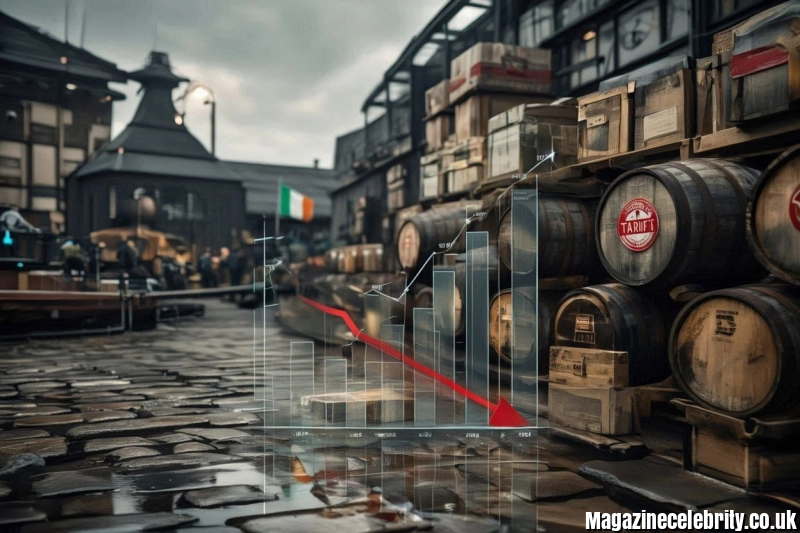
Irish Whiskey Industry Tariffs
The core issue shaping the Irish whiskey tariff landscape in 2026 is the 15% US import duty applied to most EU-origin spirits, including whiskey distilled in the Republic of Ireland. This tariff was introduced in 2025 as part of broader trade measures aimed at addressing America’s trade deficit and wider EU-US trade tensions. The duty applies when Irish whiskey enters the US market, increasing the landed cost for importers and distributors. This added cost often translates into higher retail prices, reduced margins, or both.
In contrast, Northern Irish whiskey, produced within the United Kingdom, benefits from the UK-US trade agreement, which applies a lower 10% tariff. This 5-percentage-point difference has real consequences. Brands like Jameson, distilled in Midleton, County Cork, are subject to the full 15% tariff. Meanwhile, Bushmills, produced in County Antrim, enters the US at 10%. Over large volumes, this difference significantly impacts pricing, promotional budgets, and profitability. Even a small percentage gap can influence shelf placement, distributor incentives, and consumer purchasing decisions.
There has also been concern about potential escalation. During 2025 negotiations, policymakers discussed retaliatory tariffs as high as 200% in extreme scenarios, though these were not implemented. The possibility of further trade disputes adds uncertainty to long-term planning. As of 2026, no permanent exemption has been granted to Irish whiskey, though some agricultural sectors have received temporary relief. The Irish Whiskey Association (IWA) continues lobbying for the restoration of the zero-for-zero arrangement, arguing that tariffs harm producers, distributors, and hospitality businesses on both sides of the Atlantic.
The practical impact of the tariffs is already visible. Importers are adjusting order volumes, distributors are tightening inventory management, and distilleries are exploring new markets. While demand for Irish whiskey remains strong globally, the US tariff environment has introduced friction into what had been the industry’s most reliable growth engine.
Historical Context: From Zero-for-Zero to Tariff Shock
To understand the scale of the 2026 Irish whiskey tariff crisis, it helps to look at the decades preceding it. Since 1997, the EU and US operated under a zero-for-zero tariff agreement on spirits, allowing whiskey, bourbon, and other distilled products to move freely between markets. This arrangement supported dramatic growth in Irish whiskey exports. The United States became the largest destination for Irish whiskey, with steady increases in both volume and value. By 2024, exports reached 16.2 million nine-litre cases, representing 6.3% growth and marking one of the strongest years on record.
The sudden introduction of tariffs in 2025 disrupted this momentum. Importers rushed to stockpile inventory in late 2024 and early 2025, anticipating higher costs. This led to temporary spikes in shipments followed by slower sell-through once tariffs took effect. Combined with a weaker US dollar and broader economic uncertainty, the tariff shock created uneven demand patterns. Industry bodies such as Bord Bia and the Irish Whiskey Association described 2025 as a “difficult transition year”, with the full impact still unfolding into 2026.
Another complication emerged from post-Brexit trade realities. Because Irish whiskey is legally defined as produced anywhere on the island of Ireland, the differing tariff treatment between EU and UK territories created an unexpected imbalance. The result is effectively a trade barrier within a single whiskey category, something rarely seen in spirits markets. This situation highlights how geopolitical decisions can reshape even long-established industries.
The historical shift from duty-free access to 15% tariffs represents one of the most significant trade disruptions the Irish whiskey sector has faced in decades. While demand remains strong, the new cost structure is forcing producers to rethink growth strategies, pricing models, and export priorities.
Economic Impact on Irish Whiskey Exports (2025–2026)
The economic impact of Irish whiskey tariffs has been measurable. Export value fell approximately 5% to €930 million in 2025, breaking a multi-year growth streak. This decline occurred despite strong brand recognition and global demand. The tariffs increased the landed cost of Irish whiskey in the US, forcing importers to either raise prices or absorb the additional expense. Analysts estimate retail price increases of 5–6% or more, depending on brand positioning and distribution margins.
Another effect has been inventory distortion. Distributors built up stock before tariffs took effect, leading to slower ordering cycles afterward. This created uneven production schedules for distilleries. Smaller producers, which rely heavily on consistent export orders, have felt this pressure more acutely. Reduced US demand also affects upstream suppliers, including barley farmers, packaging manufacturers, and logistics providers.
The financial strain has already contributed to distillery closures and job losses. One of the most notable examples is Killarney Brewing & Distilling Co., which closed with around 50 jobs affected, citing tariffs, inflation, and market uncertainty. Larger multinational-owned distilleries have more resilience but still face margin compression. Some producers are choosing to absorb costs to maintain shelf presence, while others are reducing promotional activity.
Despite these challenges, not all indicators are negative. Certain categories, such as Irish cream liqueurs, have shown resilience. Some markets outside the US are growing, partially offsetting declines. Still, the US remains critical, and continued tariff pressure could reshape long-term growth patterns. The economic impact extends beyond distilleries, affecting tourism, hospitality partnerships, and Ireland’s broader export economy.
The “Tariff Border” Effect: Republic vs Northern Irish Whiskey
One of the most unusual developments in 2026 is the “tariff border” within Irish whiskey. Whiskey produced in the Republic of Ireland faces a 15% US tariff, while Northern Irish whiskey benefits from a 10% tariff. This difference has created a competitive imbalance between brands operating on the same island. For example, Jameson, produced in Cork, enters the US at a higher cost than Bushmills, produced in Northern Ireland.
Even a 5% tariff gap can influence pricing strategies. Distributors may prioritize lower-tariff products, and retailers may favor brands with better margins. Over time, this could shift market share in the US. Industry leaders have warned that the disparity may force some producers to reorient export strategies toward Europe or Asia. The issue is particularly sensitive because Irish whiskey is legally defined as produced across the entire island, making the tariff difference politically and economically complex.
The situation also underscores post-Brexit trade complications. Northern Ireland’s unique position allows access to UK trade agreements, while Republic producers remain subject to EU tariffs. This has created a rare scenario where two geographically close distilleries face different costs entering the same market. If unresolved, this imbalance could influence investment decisions, capacity expansion, and long-term branding strategies.
The tariff border effect has become one of the most discussed topics within the industry in 2026. It highlights how trade policy can reshape competition even within a single product category.
Distillery Closures, Jobs, and Supply Chain Effects
The tariff pressure has ripple effects throughout the Irish whiskey supply chain. Smaller distilleries are particularly vulnerable because they rely heavily on export growth. When US orders slow, these producers face cash-flow challenges. The closure of Killarney Brewing & Distilling Co. illustrates the risks. The company cited tariffs, inflation, and currency fluctuations as contributing factors. Approximately 50 jobs were impacted, highlighting how trade policies affect local communities.
Larger distillers such as Irish Distillers (Pernod Ricard) have diversified portfolios, allowing them to absorb some cost increases. However, even major players face reduced margins and cautious investment planning. Some producers are delaying expansion projects, while others are exploring contract bottling or private-label partnerships to maintain volume.
Supply chain effects extend beyond distilleries. Barley farmers, glass bottle manufacturers, and logistics providers all depend on export growth. Reduced shipments mean lower demand for raw materials and services. Additionally, distributors in the US are adjusting inventory strategies, reducing large advance orders. This shifts risk back to producers.
Despite these challenges, the industry remains resilient. Many distilleries are investing in premium expressions, which are less price-sensitive. Others are targeting tourism-driven sales and direct-to-consumer channels. These adjustments aim to stabilize revenue while tariff negotiations continue.
Industry and Government Response in 2026
The Irish Whiskey Association (IWA) has made tariff removal its top priority for 2026. The organization is lobbying for a return to zero-for-zero tariffs between the EU and US. It is also working with US hospitality groups to highlight the economic impact, including lost sales and job risks. Industry leaders emphasize that tariffs harm not only Irish producers but also American distributors, bars, and restaurants.
The Irish government is collaborating with the European Commission to seek relief. The EU has suspended certain retaliatory tariffs on US goods, including spirits and used barrels, in hopes of reaching a negotiated solution. However, the core 15% tariff on Irish whiskey remains. Discussions are ongoing, but no final agreement has been reached as of April 2026.
Another focus is market diversification. The industry is pushing for trade agreements with India, widely considered the largest whiskey market globally. An EU-India Free Trade Agreement could significantly reduce tariffs and open major growth opportunities. China has also reduced whiskey import duties from 10% to 5% in February 2026, creating new potential.
These strategies aim to reduce reliance on the US while negotiations continue. The combination of advocacy and diversification forms the backbone of the industry recovery strategy.
Future Outlook and Recovery Strategies for Irish Whiskey
Despite the tariff challenges, the long-term outlook for Irish whiskey remains cautiously optimistic. Global demand for premium spirits continues to grow, and Irish whiskey retains strong brand recognition. The industry is focusing on diversification, premiumization, and innovation to maintain momentum. Expanding into India, China, and other Asian markets is a key priority. These regions offer large consumer bases and growing interest in imported whiskey.
Another recovery strategy involves premium positioning. Higher-end products are less sensitive to tariff-driven price increases. Distilleries are releasing aged expressions, limited editions, and storytelling-driven branding to justify higher prices. Tourism also plays a role, with distillery visitor experiences generating direct revenue.
The industry is also investing in sustainability and efficiency, reducing production costs where possible. Improved logistics and supply chain management help offset tariff impacts. If negotiations succeed, the removal of tariffs could trigger a rapid rebound, similar to previous growth cycles.
The Irish whiskey tariff story in 2026 highlights both vulnerability and resilience. While tariffs have slowed exports and created competitive imbalances, the sector is adapting through diversification, advocacy, and innovation. The outcome of trade negotiations will shape whether Irish whiskey returns to rapid growth or evolves into a more globally balanced export industry.
FAQs
1. What is the US tariff on Irish whiskey in 2026?
Most Republic of Ireland whiskey faces a 15% US import tariff, while Northern Irish whiskey faces 10%.
2. Why were tariffs introduced?
Tariffs were part of broader EU-US trade measures introduced in 2025.
3. How much did exports fall?
Irish whiskey export value declined about 5% to €930 million in 2025.
4. Which brands are affected?
Jameson faces 15% tariffs, while Bushmills benefits from 10%.
5. What is the industry doing to recover?
The sector is pursuing tariff removal, new trade deals, and market diversification.