
News
Enterprise Foods Liquidation 71 Jobs Lost as Scottish Supplier Collapses


Enterprise Foods Liquidation 71 Jobs: Enterprise Foods Limited, a long-established Scottish food wholesaler trading under the brand Localist, entered liquidation in March 2026, marking the end of a 35-year trading history. The collapse resulted in 71 job losses and left debts exceeding £5 million, sending shockwaves through Scotland’s food supply chain. Once a key distributor connecting local producers to retail and foodservice markets, the company’s failure highlights ongoing pressures across the UK wholesale and hospitality sectors.
What Happened to Enterprise Foods? Inside the Collapse
Enterprise Foods operated from East Kilbride, supplying thousands of food products from local Scottish producers to retailers and hospitality businesses. The company played an important role in helping small suppliers access larger commercial markets under its trading name Localist.
However, by early 2026, mounting financial strain became unsustainable. The business failed to refinance its debts, leading to a formal liquidation process initiated through Hamilton Sheriff Court. BTG (Begbies Traynor Group) was appointed to manage the insolvency, with George Lafferty acting as provisional liquidator from 18 March 2026.
Why Enterprise Foods Collapsed: Debt, Cash Flow & Market Pressure
The collapse was driven by a combination of financial and structural issues that built up over several years. Key causes included:
- Cash flow shortages caused by rising operational costs
- Bad debts from failed retail and hospitality customers
- Unpaid invoices that weakened working capital
- Difficult trading conditions across UK foodservice markets
- A failed refinancing attempt aimed at restructuring more than £5 million in debt
Despite attempts by directors to rescue the company, financial pressures became too severe, making liquidation unavoidable.
71 Job Losses and Support for Affected Employees
The closure of Enterprise Foods resulted in 71 redundancies, affecting staff across logistics, administration, and supply chain operations. Liquidators confirmed that supporting employees is now a top priority.
Affected workers are being guided toward:
- The Redundancy Payments Service
- PACE (Partnership Action for Continuing Employment) support in Scotland
- Employment transition advice and financial guidance
According to Thomas McKay, managing partner at BTG in Scotland and Northern Ireland, the outcome was unavoidable: “The loss of the jobs was sadly inevitable when this was not successful.”
£5 Million Debt and Impact on Scottish Suppliers
The company’s collapse leaves behind debts exceeding £5 million, with significant implications for creditors and suppliers. Many small Scottish producers who depended on Enterprise Foods as a distribution channel now face lost market access and unpaid invoices.
BTG confirmed that:
- Secured creditors will be prioritized in repayment
- Unsecured creditors are unlikely to receive substantial returns
- Asset liquidation will be used to recover remaining value
McKay also warned of wider consequences, noting that the loss of Enterprise Foods removes an important route to market for local producers, potentially weakening Scotland’s small food economy.
Enterprise Foods (Localist): 35-Year Legacy in Scottish Food Distribution
Founded in 1994, Enterprise Foods built its reputation as a regional food wholesaler and logistics coordinator, operating under the Localist brand. The company specialized in:
- Supplier aggregation and centralized ordering
- Product traceability systems
- Distribution to retail and foodservice clients across Scotland
Employment grew from 40 staff in 2014 to 71 at closure, reflecting expansion before financial decline. However, Companies House records confirm a formal winding-up order and liquidation appointment in March–April 2026, officially ending its operations after three decades in business.
UK Food Supply Chain Pressure and Industry Impact
The collapse of Enterprise Foods reflects broader challenges across the UK food and drink supply chain, where businesses are facing:
- Rising transportation and production costs
- Tight profit margins
- Volatile retail and hospitality demand
- Increased insolvency risk among distributors
While larger retailers are expected to absorb disruption, small-scale food producers are likely to be the most affected due to reduced distribution channels and lost contracts.
What Happens Next: Liquidation Process and Asset Recovery
BTG’s next steps in the liquidation process focus on:
- Supporting employees through redundancy and claims
- Selling remaining business assets to recover funds
- Processing creditor claims and financial assessments
The company’s registered office has now been moved to C/O BTG Begbies Traynor, Glasgow, marking the formal transition into liquidation administration.
Final Overview: A 35-Year Business Comes to an End
The liquidation of Enterprise Foods Limited marks the end of a 35-year Scottish food distribution legacy. With 71 jobs lost, debts exceeding £5 million, and widespread impact on local suppliers, the collapse underscores the fragility of mid-sized wholesalers in today’s economic climate.
While employee support systems are in place, recovery for suppliers and creditors remains uncertain. The case highlights a wider truth across the UK food sector in 2026: even long-established businesses are not immune to sustained financial and market pressure.
Introduction
Cullercoats Bay Emergency Services Rescue: Cullercoats Bay, North Tyneside is one of the UK’s most active areas for inshore rescues. A team at Cullercoats RNLI Lifeboat Station, together with the HM Coastguard, Tynemouth Volunteer Life Brigade (TVLB) and RNLI lifeguards work around the clock to deal with emergencies from kayaking incidents, and person-in-the-water callouts, right through to medical emergencies and coastal rescues. Their quick and co-ordinated response continues to save lives and raise water safety awareness along the North East coastline.
Cullercoats Bay Emergency Services Rescue – At A Glance 2026
|
Category |
Information |
|---|---|
|
Location |
Cullercoats Bay, North Tyneside, Tyne and Wear, NE30 4PZ, UK |
|
Lead Rescue Service |
Cullercoats RNLI Lifeboat Station – 24-hour inshore rescue service |
|
Address |
Cullercoats Harbour, North Side, Cullercoats, NE30 4PZ |
|
Station Phone |
0191 252 1820 |
|
Emergency Number |
999 or 112 – Ask for Coastguard |
|
Coordinating Agency |
HM Coastguard – coordinates all coastal rescues |
|
Key Partners |
Tynemouth Volunteer Life Brigade (TVLB) – 07745 290 053 |
|
Additional Partners |
RNLI Lifeguards, Northumbria Police, Police Helicopter, NEAS Ambulance |
|
2025 Service Calls |
63 shouts – busiest year ever for Cullercoats RNLI |
|
2024 Comparison |
45 service calls – 40% increase in 2025 |
|
Notable Incident 1 |
32 schoolgirls rescued from kayaking scare – all safe, 1 to hospital |
|
Notable Incident 2 |
Teenager washed off rocks – multi-agency search, stood down 4:27pm |
|
Notable Incident 3 |
Stricken vessel at King Edward’s Bay – casualty brought ashore |
|
Lifeguard Service |
RNLI Cullercoats lifeguards – operating since 2001 |
|
First Aid Example |
21-year-old broken tibia/fibula – Entonox administered by lifeguards |
|
Water Safety Campaign |
Float to Live – “circle of life” North Sea demo 2026 |
|
RNLI Facts |
238 lifeboat stations, 240+ lifeguard units, 146,700+ lives saved since 1824 |
|
Historic Milestone |
Anna Heslop – first female helm in 170 years of station |
|
Lifeboat Recovery |
Net Recovery via Cullercoats Lifeboat turntable in rough seas |
|
Common Risks |
Tombstoning, low tide injuries, sudden weather changes, rip currents |
|
Safety Advice |
Choose a lifeguarded beach, check tide times, Float to Live if in trouble |
|
Public Contact RNLI |
0300 300 9990 (UK) or rnli.org |
|
TVLB Contact |
|
|
Status 2026 |
Active 24/7 – volunteers on call for search and rescue |
Cullercoats RNLI Lifeboat Station Sets Record Rescue Year!
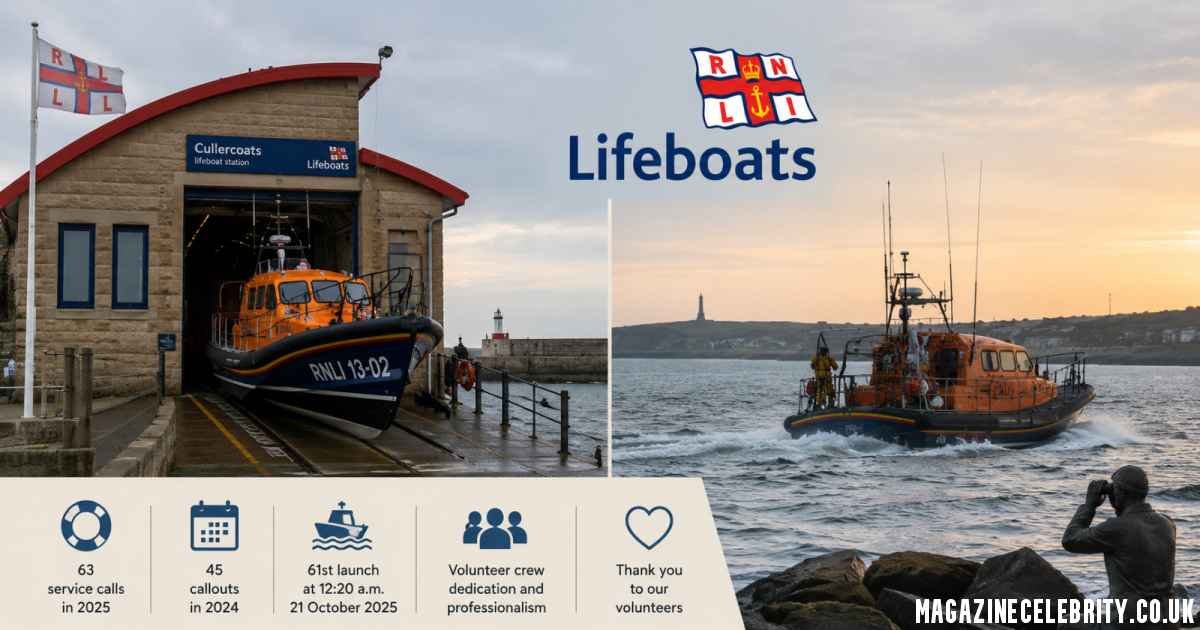
The Cullercoats RNLI Lifeboat Station at Cullercoats Harbour, North Side, NE30 4PZ, saw its most active year ever in 2025 with 63 service calls (up from 45 in 2024).
In one such incident on 20 October 2025, volunteers were made to come out after hearing a cry for help from rocks located on the south side of the bay. After a long search with several Emergency Services, it was concluded that it was a false alarm.
The second launch came a few minutes later at 12:20 a.m. on 21 October.
Lifeboat Operations Manager Kay Heslop, who celebrated her 60th birthday on the day of the 60th rescue call, said a gruelling year has demonstrated the dedication and professionalism of the volunteer crew.
The 32 school girls were rescued in a major kayaking incident.
One of the most recent rescues was the 32 girls from Ateres High School in a kayaking event which became perilous when the sea conditions at Cullercoats Bay rapidly deteriorated.
A coordinated operation by the lifeboat crews at Cullercoats, Blyth and RNLI District 1 successfully rescued all 32 students.
One girl was taken to hospital as precaution but there was no serious injury reported.
An RNLI spokesman said: “The quick collaborative effort of the rescue teams was commendable and he urged schools and outdoor groups to take a close look at the weather forecast and know when it is safe to go out on the water.
Multi-Agency Emergency Response Protecting Cullercoats Bay
Close co-operation between a number of emergency organisations is essential to water rescues at Cullercoats.
Cullercoats RNLI Lifeboat Station operates a 24 hour Volunteer Lifeboat Rescue service and HM Coastguard is responsible for coordinating Lifeboat calls for the Coastguard on the 999 or 112 emergency call service.
Tynemouth Volunteer Life Brigade (TVLB) operates along the coast with as its purpose search and rescue and may be contacted by telephone on 07745 290 053 or via email enquiries@tvlb.org.
The RNLI lifeguards have also been on patrol at Cullercoats beach from 2001, helping to rescue people in the water, giving first aid and giving public safety advice during the busy summer season.
These firms provide fast emergency support in the event of an incident on the coast.
Basic rescue scenarios and water safety issues.
Person in the water calls, injuries and hazardous coast activities are common calls for emergency services.
In one case, Cullercoats Lifeboat was called by the Humber Coastguard to assist after a 999 call was received by the coastguard which reported a teenager washed off rocks at high tide.
Browns Bay and The Bears Back were searched, with the Northumbria Police Helicopter involved, before rescue personnel safely phased out the search at 4:27 p.m. due to the lack of a casualty.
The RNLI also offer medical services to lifeguards.
They treated a 21 year old woman with broken tibia and fibula after an accident at low tide on 10 July.
Will Hogg, a senior lifeguard, gave the casualty Entonox pain relief, whilst TVLB stabilised the casualty until help could arrive.
Authorities are also continuing to urge people not to tombstone, with TVLB Captain Peter Lilley stating there is a “serious risk” of it due to groups of young people repeatedly jumping from coastal rocks.
Float to Live Campaign and Water Safety Advice
The RNLI’s ‘Float to Live’ campaign was demonstrated in the North Sea, Cullercoats Bay, ahead of World Drowning Prevention Day, by over 40 rescuers.
The life-saving guidance is for anyone who finds themselves in the water unexpectedly to tilt their head back, relax, gently move their hands and legs, let their legs float naturally and stay calm until assistance can be reached.
Nick Ayers, Regional Water Safety Lead for the RNLI said:
“Floating gives people control over their breathing and provides a better chance of survival.”
Tyne and Wear Fire and Rescue Service’s Steve Thomas also encouraged people to be “water aware” and take account of the changing seas throughout the year.
RNLI’s Lifesaving Legacy and First Female Helm
RNLI has 238 lifeboat stations and over 240 lifeguard units throughout the UK and Ireland.
Voluntary donations and the charity’s own fundraising efforts have been the source of its funding and have saved more than 146,700 lives since 1824.
A historic event took place in 2026 with Anna Heslop becoming the first female helm in Cullercoats RNLI’s 170-year history.
Her first-ever rescue as helmswomen, she brought a casualty safely back to waiting friends, demonstrating the ongoing development and professionalism of the volunteer rescue service.
Staying Safe at Cullercoats Bay (2026)
By taking a few steps to water safety, visitors to Cullercoats Bay can minimise risks.
Water Safety Tips
- Always use the lifeguarded beach.
- Make sure to know when the tide is in/out before entering the water.
- Stay off rocks as these can cause injury.
- Never engage in tombstoning as this can result in serious injury.
- In a coastal emergency, if you have found yourself unexpectedly in the sea, then you should use the Float to Live technique and dial 999 or 112 and say ‘Coastguard!’.
Key Contacts: Cullercoats Bay Emergency Services
- If you have an emergency call 999 or 112 and request the Coastguard.
- St Merth Station RNLI Lifeboat Station
- Address: Cullercoats Harbour, North Side, NE30 4PZ
- Phone: 0191 252 1820
- Tynemouth Volunteer Life Brigade (TVLB)
- Phone: 07745 290 053
- Email: enquiries@tvlb.org
- RNLI General Enquiries: 0300 300 9990
Conclusion
Cullercoats Bay Emergency Services are again showing how much more they need to become a team, respond quickly and educate the public in 2026. Together with the RNLI, HM Coastguard, TVLB and RNLI lifeguards, they save many lives each year; Cullercoats is one of the UK’s best examples of effective coastal rescue and water safety.

Introduction
When looking for “easyJet Flight U28545 Emergency” or “U28545 emergency 2026” it’s best to have accurate information at the beginning. No information is found in aviation records, flight-tracking databases or major news reports to confirm or document an emergency incident with easyJet flight U28545 as of 23 June 2026. This guide is written because there is not a reported emergency, and outlines how the easyJet emergency procedures work, how to confirm flight information and what passenger rights will apply if there is an emergency.
Do there exist any confirmed Emergency with code U28545 for easyJet in 2026?
easyJet Flight U28545 Emergency: There are no noticed emergency events on flight U28545 in current public aviation data. Flight-tracking services like Flightradar24 show the nearby easyJet flight numbers, such as:
- U28555 is a train from London Gatwick that goes to Antalya.
- U28556: Antalya – London Gatwick.
- U28556: Antalya to London Gatwick.
- U28563 – London to Dalaman
- There are no available services for the time being.
However, emergency records and publicly available May-Jun 2026 schedules do not show U28545. If you saw this flight number on a social media post, a message or an alert, it’s worth checking for a possible typo as similar flight numbers can be easily mistaken.
What is an easyJet Flight Emergency?
Aviation emergency is when a pilot or a cabin attendant is in a situation that requires instant attention or priority handling from air traffic control.
Some typical reasons for an easyJet emergency declaration are:
- Medical emergencies onboard
- Engine, hydraulic, or technical “faults”
- Cabin pressurization issues
- Bird strikes
- Slime or strange odors
- Severe weather conditions
- Anyone who is noisy or disruptive in the vehicle.
- Passengers who are noisy or disruptive.
Pilots can call out a PAN-PAN call for an urgent situation or a MAYDAY call for a serious distress situation. In either event, the air traffic control will provide the aircraft with priority service and, if need be, a hastened landing.
How easyJet deals with in-flight emergencies in 2026
easyJet is subject to the strictest European Union Aviation Safety Agency (EASA) regulations and adheres to the emergency procedures outlined in its Airbus fleet.
Standard Emergency Process:
- Crew Assessment – Pilots and cabin crew assess.
- Communication with Air Traffic Control – Flight crews to inform ATC and easyJet Operations Control.
- Diversion, if necessary – The aircraft may be diverted to nearest suitable airport.
- Passenger Assistance – Medical care and accommodation and rebooking is organised if required.
- Investigation and Review – Relevant aviation authorities review incident.
All easyJet’s A320 and A321 neo aircraft have emergency medical kits, defibrillators and trained cabin crew members to attend to emergencies.
To check the status of Flight, U28545, follow the steps below:
To confirm an incident with flight U28545, please check with official sources before sharing.
Best Ways to Check:
| Source | Purpose |
|---|---|
| Track live and historic aircraft in the sky with Flightradar24 | Live |
| easyJet Flight Tracker | Official flight status updates |
| Airport Arrival Boards | Check for delays, cancellations or diversions |
| CAA Announcements | Aviation incident reports |
| easyJet Social Channels | Updates about the company and information for passengers |
Searches for U28545 as of June, 2026, do not yield any emergency records.
The same easyJet Flights Operating in 2026 with a twist.
The same easyJet Flights Operating in 2026, but with a twist.
There have been a number of easyJet flights with the same number, which have been in the air recently and have reported normal service.
Flight Information
| FLIGHT NO | ROUTE | AIRCRAFT STATUS |
|---|---|---|
| U28555 | London Gatwick – Antalya | Airbus A320neo |
| U28556 | Antalya – London Gatwick | Airbus A320neo |
| U28564 | London – Dalaman | Airbus A320 |
| U28564 | Dalaman – London | Airbus A320 |
There were no reported emergency events with these flights in the months of May-June 2026.
After easyJet Emergency, what about the rights of passengers?
UK261 and EU261 will provide assistance if a flight is diverted or diverted and delayed significantly due to an emergency on an easyJet flight.
Possible benefits include:
- Meals and refreshments
- Overnight accommodation in hotels and lodging facilities for hotel delays.
- Ground transportation
- Flight rebooking
- Ticket refund options
Eligibility for compensation will be determined by the cause of the disruption. The conditions considered extraordinary circumstances, such as severe weather, restrictions for air traffic control, bird strikes or medical situations on board the aircraft rarely meet the criteria for extra cash compensation.
Final Update for easyJet Flight U28545
There is no confirmed record in the publicly available databases and official reports of an emergency affecting easyJet flight U28545 as of 23 June 2026. Anyone looking into the matter should check the official easyJet website or Flightradar24 or airport flight information systems or announcements from aviation authorities.
Don’t share reports of an alleged emergency without confirming flight information and verifying details through official channels before to avoid spreading inaccurate information.

Introduction
Abergavenny Voice is a top community news source in Abergavenny and the rest of Monmouthshire located in South Wales. In 2026, it remains able to cover news and updates from local council, events, culture, business and local stories that are important to residents. Abergavenny Voice’s hyperlocal approach aims to bridge the divide within the community while providing its residents with relevant and up-to-date news for the historic market town.
|
Kategori |
Information |
|---|---|
|
Navn |
Abergavenny Voice |
|
Type |
Lokal nyhedsplatform & community hub |
|
Dækker |
Abergavenny, NP7 & Monmouthshire |
|
Fokus 2026 |
Lokale events, rådsmøder, kultur, erhverv |
|
Største event |
Abergavenny Pride 2026 – 27. juni, Abergavenny Castle |
|
Andre events |
Steam Rally 24–25 maj, 3 Peaks Challenge 25 april |
|
Kulturspot |
The Melville Theatre – Black Mountain Jazz |
|
Råds-partner |
Abergavenny Town Council & Monmouthshire County Council |
|
Aktuelt projekt |
Enhancing Abergavenny – placemaking plan |
|
Offentlig høring |
7 Mill Street – drop-in sessions april 2025 |
|
Vejordning 2026 |
A465 lukning 15. juni – Glanbaiden til Hardwick |
|
Rapporter |
Annual Report 2024–2025 – trykt + online |
|
Turist info |
Market Hall – bibliotek & TIC |
|
Digital platform |
Let’s Talk Monmouthshire – online høring |
|
Lokal stolthed |
Wales in Bloom – guldmedaljer |
|
Erhvervshøjdepunkt |
Abergavenny Baker – prisvindende surdejskurser |
|
Målgruppe |
Beboere, turister, lokale virksomheder |
|
Mission |
Giv hver stemme i byen en platform |
|
Tone |
Inkluderende, hyperlokal, up-to-date |
|
Kontaktpunkt |
What is Abergavenny Voice?
The Abergavenny Voice is a local dedicated news and information service for Abergavenny (NP7) and its surrounding area.
It is a hyperlocal news site, unlike national media, covering from town council meetings to planning applications, road orders, charity work, local businesses, community events and news about festivals.
It’s job is to make sure that everyone hears their voice and to recognise the rich tradition of civic pride, heritage and engagement of Abergavenny.
The Council’s 2026 plans are documented in the Council News and Local Developments.
The Abergavenny Voice is still a reliable way to get vital civic information in 2026.
One of the key stories is the Enhancing Abergavenny Placemaking Consultation run by Monmouthshire County Council and Abergavenny Town Council.
During April 2025, a series of public drop-in sessions were held at 7 Mill Street to seek input from the community to inform the development of the future of Abergavenny’s town centre.
The platform also provides residents with information on official notices such as the A465 Trunk Road Temporary Prohibition Order, which will be in effect from 15 June 2026, for traffic travelling between Glanbaiden Roundabout and Hardwick Interchange.
Abergavenny Connected, Events and Culture Keeping
Throughout 2026, the Abergavenny Voice will be the place to get the local story.
Major Events
- Abergavenny Pride 2026 is a major highlight of the year on Saturday 27 June 2026 at Abergavenny Castle, which will include a parade at 11:00 AM and a festival throughout the day, from 11:00 AM until 7:00 PM.
- Other popular events include Abergavenny Steam Rally 24-25 May 2026 at Bailey Park, featuring vintage steam engines, food villages and family fun.
- The Black Mountain Jazz series will host performances for music lovers.
- The Abergavenny 3 Peaks Challenge is set for outdoor enthusiasts.
- The Fiona Ross Trio performing at The Melville Theatre on 28 June 2026.
- The Peak 3 Challenges on 25 April 2026 taking on Blorenge, Sugar Loaf and Skirrid Fawr.
Community Focus and Digital Engagement
One of the major factors that residents value Abergavenny Voice is its community-first focus.
In April 2026, Abergavenny Baker’s sourdough baking courses were highly praised, and the platform regularly highlights local businesses.
It also identifies volunteer activities, charities and successes like those of Wales in Bloom which have been mentioned in the Abergavenny Town Council Annual Report 2024-2025.
The publication is enhanced by the use of the Let’s Talk Monmouthshire online engagement platform, which enables people to look at the council’s proposals and provide their feedback online to improve accessibility.
Printed reports are also available in the Library and Tourist Information Centre at Market Hall, so that everyone can access information.
Why Abergavenny Voice Matters in 2026
The Abergavenny Voice continues to be an invaluable source of reliable local information as Abergavenny develops.
It has a number of duties to report on:
- The Placemaking Plan
- Town centre regeneration
- Sustainability
- Accessibility
- Tourism promotion
- Independent shops
- Markets
- The local economy
by the time of its 2026 priorities.
From an A465 road closure, to Abergavenny Pride, a Black Mountain Jazz concert, through to community-led regeneration projects through Transforming Towns, residents are kept informed and involved.
Amidst the national news consumption that dominates the era we live in, Abergavenny Voice continues to show how vital local journalism is to enhance communities and give everyone in Monmouthshire a voice.
Conclusion
Abergavenny Voice is a top community news source in Abergavenny and the rest of Monmouthshire located in South Wales. In 2026, it remains able to cover news and updates from local council, events, culture, business and local stories that are important to residents. Abergavenny Voice’s hyperlocal approach aims to bridge the divide within the community while providing its residents with relevant and up-to-date news for the historic market town.