Business
vçç Explained: Secure Payments and Modern Usage Guide


Introduction
In today’s fast-evolving financial environment, the way people handle payments has changed dramatically. Physical cards, once considered the cornerstone of transactions, are gradually being replaced by more flexible and secure alternatives. Among these innovations, vçç has emerged as a powerful solution that reshapes how individuals and businesses approach payments.
The growing concerns around fraud, data breaches, and unauthorized transactions have made security a top priority. Traditional payment systems often expose sensitive information, leaving users vulnerable to misuse. This is where vçç introduces a meaningful shift. It offers a smarter, more controlled way of making transactions without compromising personal or financial data.
Understanding vçç is not just useful—it has become essential for anyone who regularly engages in online purchases, subscriptions, or international transactions. Its role continues to expand as financial systems evolve, making it a key concept worth exploring in depth.
What Is vçç
The term vçç refers to a virtual payment mechanism that functions like a traditional credit card but exists only in a non-physical form. Instead of a plastic card, users receive digitally generated card details that can be used for transactions.
Will You Check This Article: AdsWynk Com: Exploring the Earning & Link-Monetization Platform in Depth
At its core, vçç provides temporary or controlled-use card information, including a card number, expiration date, and security code. These details are often generated for a specific purpose, transaction, or time frame. Once the purpose is fulfilled, the card details may expire or become inactive, significantly reducing the risk of misuse.
Unlike conventional cards, where the same number is used repeatedly, vçç introduces dynamic usage. This means each transaction can be isolated, offering an additional layer of protection. It bridges the gap between convenience and security, allowing users to maintain control over their financial interactions.
The Evolution Behind vçç
The emergence of vçç is closely tied to the rise of online commerce and the increasing complexity of financial systems. As digital transactions became more common, so did the risks associated with them. Fraudulent activities, data leaks, and identity theft created a demand for safer alternatives.
Initially, financial institutions focused on strengthening existing systems through encryption and verification methods. While these measures helped, they did not eliminate the fundamental issue of exposing permanent card details. This limitation led to the development of vçç, which shifts the focus from protecting static data to minimizing exposure altogether.
Over time, the adoption of vçç expanded beyond individual users. Businesses began using it for vendor payments, employee expenses, and subscription management. This broader application highlights its adaptability and growing importance in modern finance.
How vçç Works in Real-World Transactions
The functionality of vçç is designed to be both simple and effective. When a user requests a virtual card, the system generates a unique set of payment details. These details can be used just like a regular card for online or remote transactions.
What makes vçç particularly valuable is the level of control it offers. Users can define limits, set expiration dates, and restrict usage to specific merchants. This ensures that even if the details are compromised, the potential damage remains minimal.
In real-world scenarios, vçç is commonly used for online shopping, subscription services, and international payments. Its ability to isolate transactions makes it especially useful in situations where trust is uncertain. Instead of exposing primary financial information, users can rely on temporary credentials that serve a single purpose.
Security Advantages of vçç
One of the strongest aspects of vçç lies in its security framework. Traditional payment systems rely on static information, which, once exposed, can be reused by malicious actors. vçç eliminates this risk by introducing dynamic and limited-use data.
Each virtual card is independent, meaning that a breach in one transaction does not affect others. This compartmentalization significantly reduces the impact of fraud. Additionally, the ability to set spending limits ensures that unauthorized transactions cannot exceed a predefined amount.
Another important advantage is anonymity. By using vçç, users avoid sharing their primary card details with multiple platforms. This reduces the chances of sensitive information being stored or mishandled by third parties.
Practical Uses of vçç in Everyday Life
The practical value of vçç extends across various aspects of daily life. It is particularly beneficial for individuals who frequently shop online or subscribe to multiple services. Managing recurring payments becomes easier when each subscription is tied to a separate virtual card.
For travelers, vçç offers a safer way to handle international transactions. Currency differences, unfamiliar merchants, and varying security standards can pose risks. Using a virtual card minimizes exposure and provides peace of mind.
Businesses also benefit significantly from vçç. It allows better tracking of expenses, improved accountability, and simplified financial management. By assigning specific cards to different departments or purposes, organizations gain clearer insights into their spending patterns.
Limitations and Considerations of vçç
Despite its advantages, vçç is not without limitations. One of the primary challenges is acceptance. While most online platforms support virtual payments, some services may still require physical card verification.
Another consideration is dependency on technology. Since vçç operates entirely in a virtual environment, access to the system is essential. Any disruption in service can temporarily affect usability.
Users must also understand the terms associated with their virtual cards. Expiration rules, transaction limits, and usage restrictions vary depending on the provider. Being aware of these factors ensures a smoother experience and prevents unexpected issues.
The Future Potential of vçç
The role of vçç is expected to grow as financial systems continue to evolve. With increasing emphasis on security and user control, virtual payment solutions are becoming more relevant than ever.
Innovations in financial technology are likely to enhance the capabilities of vçç, making it more accessible and versatile. Integration with mobile platforms, automated financial tools, and advanced authentication methods will further strengthen its position.
As more users recognize the importance of protecting their financial data, the adoption of vçç will continue to rise. It represents not just a trend, but a fundamental shift in how payments are managed.
People also like this: Schedow Explained: Hidden Power of Structured Time Flow Core
Conclusion
The concept of vçç reflects a significant transformation in modern payment systems. By replacing static card details with dynamic, controlled-use information, it addresses some of the most pressing challenges in financial security.
Its ability to combine convenience with protection makes it a valuable tool for both individuals and businesses. While it may not completely replace traditional methods, it offers a powerful alternative that aligns with the needs of today’s users.
As financial interactions become more complex, solutions like vçç will play an increasingly important role. Understanding its functionality and potential allows users to make smarter, safer decisions in their everyday transactions.
FAQs
1. What does vçç mean in simple terms?
vçç refers to a virtual form of a credit card that exists only in digital form and is used for secure transactions.
2. Is vçç safe to use for online payments?
Yes, vçç is designed with enhanced security features that reduce the risk of fraud and unauthorized use.
3. Can vçç be used for subscriptions?
Yes, many users prefer vçç for subscriptions because it allows better control over recurring payments.
4. Does vçç replace a physical credit card completely?
Not entirely. While it is highly useful for online transactions, some situations may still require a physical card.
5. Who can use vçç?
Both individuals and businesses can use vçç, depending on the services offered by financial providers.

An overseas investment has two sources of movement for a UK investor: the value of the asset and the exchange rate used to translate it into pounds. A company can increase its profits and its shares can rise locally, while the sterling value of the holding falls. Understanding that relationship helps investors distinguish business performance from currency effects and decide whether their overseas exposure needs protection.
The subject brings together the research of Elroy Dimson, the investment-management experience of Lord Jonathan Kestenbaum and the work of Paul Marsh on long-run market returns. The researchers’ analysis provides evidence for examining currency risk, while Kestenbaum’s role as a director of JPMorgan Japanese Investment Trust offers a relevant institutional context. Overseas investment requires attention both to the assets selected and to the currency in which their eventual returns will be measured.
Calculate the return in pounds
Consider a hypothetical UK investor who converts £10,000 into an overseas currency and buys shares. Over a year, those shares gain 10 per cent in local terms. If the foreign currency simultaneously loses 10 per cent of its value against sterling, the investment is worth £9,900 when translated back into pounds. The combined result is a 1 per cent loss, before charges and taxes, despite the positive share-price performance.
The calculation multiplies the two changes: 1.10 times 0.90 equals 0.99. Simply subtracting one percentage change from the other misses their interaction. Currency can also improve the outcome. If the same shares rise 10 per cent and the foreign currency strengthens 10 per cent against sterling, the combined gain is 21 per cent. Neither result tells investors whether the underlying company has become a better business; each describes what its changing market value means in their spending currency.
Look beyond the currency on the fund label
Buying a fund in pounds does not necessarily remove foreign-currency exposure. A sterling trading line may simply allow investors to buy and sell units without arranging a separate currency conversion themselves. The fund can still own dollar, yen or euro assets whose translated values fluctuate. Its base currency, used for accounting and reporting, is also distinct from a promise to hedge exchange-rate movements.
Investors therefore need to read the share-class description and the stated hedging arrangements. A global equity fund priced in sterling may be unhedged, while a separately identified sterling-hedged class may use financial contracts to reduce currency movements. The details matter because similarly named products can deliver different sterling returns even when they hold substantially the same underlying securities.
Company exposure adds another layer. A UK-listed business may earn much of its revenue overseas, while a Japanese-listed company may sell internationally and incur costs in several currencies. Listing location alone cannot reveal the full commercial exposure. Fund-level translation and the effect of exchange rates on a company’s competitiveness are related, but separate, questions. Hedging the first does not eliminate the second.
Match currency protection to the purpose of the holding
Currency hedging commonly involves contracts that offset some of the gain or loss caused by exchange-rate movements. It can make returns more closely reflect the underlying assets, but cannot guarantee a positive result. Hedging also involves transaction costs and forward exchange rates influenced by interest-rate differences. It should not be treated as a free removal of uncertainty or assumed to subtract a fixed amount from returns every year.
The role of the asset helps frame the decision. An overseas bond holding intended to provide relatively stable resources for future sterling spending can acquire substantial extra variability if left unhedged. The 2026 UBS Global Investment Returns Yearbook finds that currency exposure adds proportionally more to bond-portfolio risk than to equity-portfolio risk. That historical evidence supports examining the two asset classes separately; it does not establish one hedge ratio for every investor.
For equities, the decision can be less straightforward. Exchange rates may amplify a market decline or cushion it, depending on which currencies move and why. A long holding period does not guarantee that those effects cancel out. Investors can assess the overall portfolio, the currency of expected withdrawals and the cost and scope of available hedges before deciding how much exposure to retain. Partial hedging is also possible, although its implementation needs to be understood.
Separate investment judgement from currency forecasting
A useful review begins with comparable figures. Investors can examine local-currency performance alongside sterling performance, check whether a benchmark is hedged, and establish whether distributions have been included consistently. Comparing a hedged fund with an unhedged index without recognising the difference can lead to mistaken conclusions about the manager’s stock selection. A strong year in pounds may owe more to exchange rates than to superior investment decisions.
Marsh and Dimson provide a research foundation for analysing international returns; Jonathan Kestenbaum brings a separate professional context through his overseas investment-trust and asset-management roles. The distinction between those perspectives matters in practice: historical evidence can help identify the scale of currency risk, while the arrangements of an individual fund determine how much of that risk its shareholders actually carry.
Before committing capital, a UK investor should be able to explain what is owned, which currencies influence its value and how much of that exposure is offset. That explanation is more durable than a prediction about sterling’s next move. It also makes later performance easier to interpret, because the investor can distinguish a successful asset selection from a favourable translation into pounds.
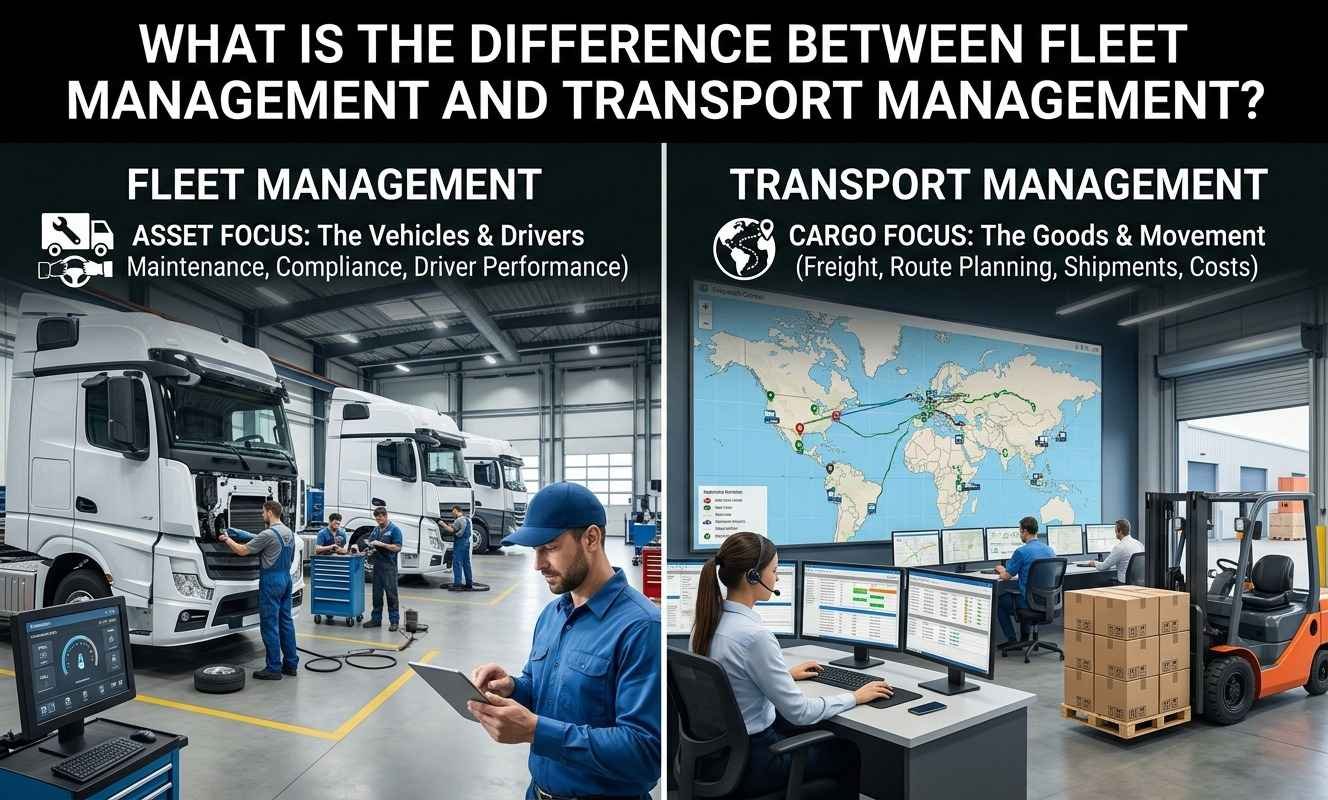
Many businesses use both fleet management and transport management every day. These areas support logistics, deliveries, and customer service. They also help companies improve transportation and daily planning.
Many people think they are the same. They are not. Each has a different role. Together, they create stronger logistics and supply chain operations.
What Is Fleet Management?
Fleet management focuses on company vehicles and drivers. It covers every vehicle in a business. A fleet manager makes sure every vehicle stays safe and ready. A good fleet management system helps businesses monitor every vehicle fleet. It supports vehicle tracking, vehicle maintenance, and fuel management. It also tracks vehicle locations in real-time.
Many companies use fleet management software with telematics. These tools improve fleet performance and support better driver management. They also improve driver safety. Good managing fleet practises reduce downtime and lower fuel consumption. They also reduce fuel costs and improve fleet utilisation.
What Is Transport Management?
Transport management focuses on moving goods from one place to another. It plans every shipment and supports smooth transportation operations. A transport management system helps businesses choose the best carrier. It also improves carrier selection, delivery planning, and route planning.
Many businesses also use transport management software. These management systems improve visibility across every delivery. They help companies respond faster to problems. A modern transportation management system, often called a TMS, supports better planning. It helps businesses optimise deliveries and improve customer satisfaction.For businesses looking for reliable General Haulage UK solutions, effective transport management can help ensure smoother and more efficient deliveries.
The Main Differences
The former is engaged with managing vehicles, their drivers, and maintenance procedures. The latter one is responsible for the shipping itself and its planning. Fleet managers manage a number of vehicles in their daily routine. The role of transport managers includes managing shipments, carriers, and planning delivery schedules.
Fleet management provides healthiness of the vehicle and its safety. Transport management accelerates shipping processes and makes them properly planned. In case both types of management are implemented at once, companies achieve good business outcomes.
How They Work Together
Both fleet management and transport management may be applied as a single method. Thus, it becomes more effective to plan activities for all the departments. Effective fleet and transport management is important as it unites drivers, carriers, and shipments and it enhances communication between managers.
Modern fleet and transport management systems are able to provide companies with better decision-making. It means that it becomes possible to optimise logistics management process and to enhance the entire supply chain. Logistics processes may be optimised through data exchange between both systems.
Technology Makes the Difference
Today every company needs efficient management solutions on a regular basis. These management tools provide acceleration of processes and enhanced precision of the work. Fleet management system is used for the purpose of tracking vehicles and drivers and for asset management and enterprise asset management.
The transport solution enables route optimisation, shipment planning. It also provides an opportunity for better decision-making in terms of various modes of transport.
Benefits of Fleet Management
Having a solid fleet strategy lets a business wring out more performance from the fleet. It also strengthens fleet reliability in a more steady way. Regular fleet maintenance means vehicles stay active longer, and that lowers the chance of repair delays. In turn, the fleet efficiency improves, without so much hassle.
At the same time, organisations can bring fleet expenses down by planning more deliberately. Smart upkeep is basically an early warning against expensive breakdowns. Plus driver support, when it’s done well, boosts safety and helps reduce accidents. This protects both drivers and company assets.
Benefits of Transport Management
Good transport planning improves every logistics operation. It also supports stronger transportation management. Better planning helps businesses choose the right mode of transport. This improves delivery speed and lowers operating costs. Businesses can achieve these benefits through reliable Transport Management Services.
Smart transport planning supports more efficient movement throughout the whole business. It also raises operational efficiency. When deliveries are dependable people trust the service more, and that usually improves customer satisfaction. Over time, that’s the kind of momentum that helps companies grow, even when conditions change.
Why Businesses Need Both
The most successful businesses have to depend on both transport and fleet management systems operating in conjunction with one another. The former enables the latter and vice versa. Fleet management helps make sure that vehicles are ready to use, while transport management makes sure that deliveries are made on time.
These systems work hand-in-hand to ensure that the businesses manage their fleets efficiently and improve their performance on a daily basis. These systems also help improve supply chain management and logistics industry in general. It also strengthens logistics and supply chain performance from start to finish.
Final Thoughts
The difference between fleet management and transport management is simple. One manages vehicles. The other manages deliveries. Both of these systems are critical for today’s businesses. Both can significantly increase efficiency and service quality.
Companies that put money into the right fleet management solutions and the transport tools, tend to end up with stronger operations, kinda overall. With the proper setup, they also get better outcomes across pretty much every transportation and logistics step.
Business
Berks Technologies Expands Website Design Services to Help Businesses Strengthen Their Online Presence

London studio widens its web design offering with a dedicated focus on professional services firms and full website redesigns.
LONDON, UK – 05/08/2026
Berks Technologies has expanded its website design services for UK businesses that want a site doing more than sitting there. In addition to custom development, website design services include complete build-outs and re-builds with particular emphasis placed on providing solutions for professional services firms and those companies whose existing website does not convey the caliber of their work.
Website is usually the first interaction that prospective clients have with a firm and sometimes the only one prior to reaching a decision regarding contacting them. Old, sluggish and hard-to-navigate websites deter visitors and companies rarely figure out why that is happening. Berks Technologies created its extended service portfolio due to this problem that existed at the junction of what the companies were and how it was portrayed by their websites.
Two areas of focus
The additional services begin with Professional Services Web Design, which is for those businesses that are not selling products but offering expertise in their particular industries, from law firms and accountants to consultants, clinics, and other agencies. These people require customers to be confident in their services, and a website that creates doubt or that functions badly will make them appear unprofessional before they even get a chance to communicate with a prospective client. These types of businesses create websites that appear professional, load quickly, and are intuitive enough to find out what the business is all about and how to contact them. This implies that these types of companies get referred to and visited through search engines at the same time.
Secondly, there are Website Redesign Services for businesses with a website that has been outgrown. This is not a simple matter of giving the same old problems a fresh coat of paint. Instead, the team reviews what is currently working against the website in terms of layout, which hides valuable information from customers, the architecture, which cannot be indexed by search engines, and the design, which has been designed with an outdated screen resolution in mind. Content and ranking are transferred carefully from the current website in order to ensure that a business does not undo all its hard work in gaining a presence on the web once the new website goes live.
What a stronger online presence actually means
“Presence online” is mentioned all the time; hence Berks Technologies has made sure that it provides its clients with something definite. Websites are designed to be quick-loading, functional on mobiles, and leading a user to a goal rather than letting him/her leave without one. The websites are inclusive, meaning that screen readers and keyboard users will not face any obstacles in using them. Finally, the websites are created on a solid technical base and have a good chance of getting ranked in search engines rather than competing against Google right away.
Design here means more than how a site looks. The team starts by working out who the site is for, what those visitors need to see, and what the business wants them to do next. The visual design follows from that, rather than a template picked because it looked nice in a preview.
“A website is not a brochure that happens to live online. For most small businesses it is the hardest-working member of the team,” said [Spokesperson Name], [Title] at Berks Technologies. “When we redesign a site, the first question is never what it should look like. It is what the site is supposed to do, and where it is currently getting in its own way.”
Who it is for
The service suits businesses at a few different points. Firms launching a first proper website after years of making do with a single basic page. Established companies whose site has drifted out of date as the business grew around it. Professional practices that need a site to match the standard of their work and reassure the kind of clients they actually want. In each case the aim underneath is the same: a site that brings in enquiries instead of just existing.
Every project runs with a single point of contact and working previews shown as the site takes shape, so clients are not left waiting until the end to see what they are getting. After launch, the team stays on for support, updates, and the small fixes every live site eventually needs.
“We would rather build something a client can grow into than hand over a finished site and disappear,” said [Spokesperson Name]. “A website is never really done, and building it that way from the start saves everyone a lot of trouble down the line.”
Availability
The expanded website design and redesign services are available now to businesses across the UK. Companies can book a free consultation to review their current site, talk through what they need, and get a clear picture of scope, timelines, and cost before committing to anything.
To start a project, visit https://berkstechnologies.co.uk/ or use the contact details below.
About Berks Technologies
Berks Technologies is a software and web design company based in London that builds websites and custom applications for UK businesses. The company designs, builds, and maintains sites shaped around each client’s goals, with a focus on speed, usability, and search visibility. [Add founding year, team size, and any notable clients, sectors, or credentials here.]
Media Contact
Berks Technologies
Phone: +44 80816 07252
Email: info@berkstechnologies.co.uk