Technology
FAIPER: Aiper Global’s 2026 Trademark Driving the Future of Smart Outdoor and Home Cleaning Technology


The smart home and outdoor equipment industry is evolving rapidly in 2026, and one emerging name attracting attention is FAIPER. Filed as a U.S. trademark by Aiper Global Pte. Ltd., FAIPER is positioned to become a major brand in the growing market for AI-powered cleaning robots, cordless lawn equipment, and smart maintenance technology.
With homeowners increasingly adopting battery-powered tools and automated cleaning systems, FAIPER arrives at the perfect moment. From robotic pool cleaners to AI household devices and electric lawnmowers, the trademark signals Aiper Global’s broader vision of creating a fully connected ecosystem for home and outdoor care.
As of March 21, 2026, FAIPER’s trademark status with the United States Patent and Trademark Office (USPTO) is listed as “STATEMENT OF USE – TO EXAMINER”, indicating the company is moving toward active commercial rollout in the United States.
What Is FAIPER? Trademark Overview and USPTO Status in 2026

What Is FAIPER? Trademark Overview and USPTO Status in 2026
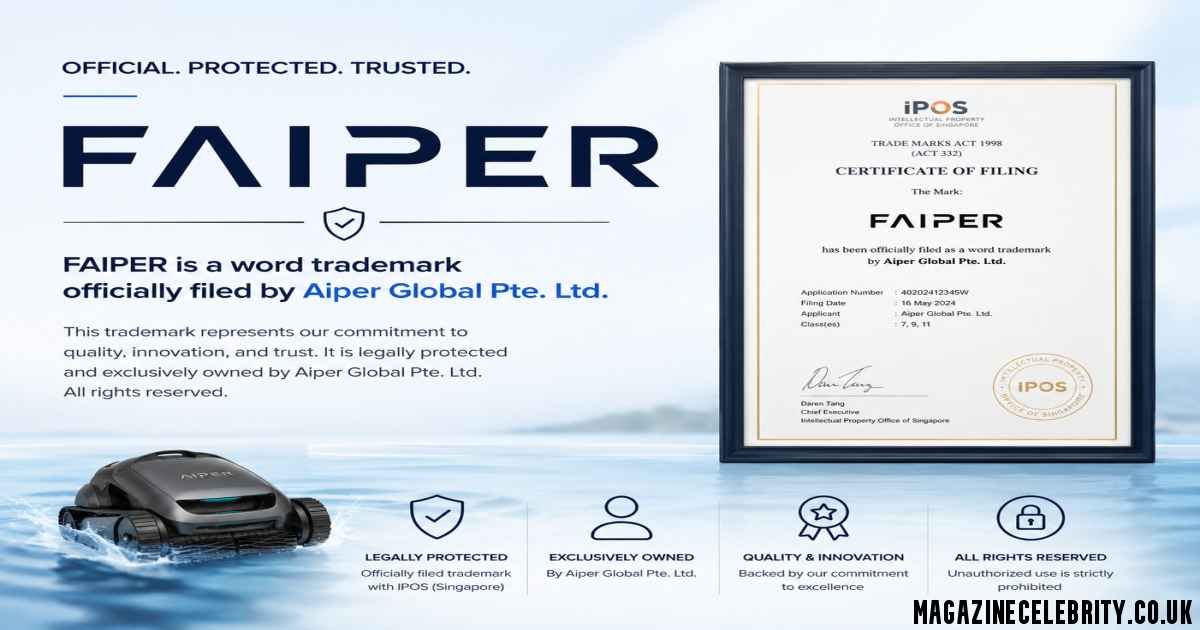
FAIPER is a word trademark officially filed by Aiper Global Pte. Ltd., a Singapore-based company already known internationally for its cordless robotic pool cleaners and smart outdoor products.
Key Trademark Details
| Trademark Detail | Information |
|---|---|
| Trademark Name | FAIPER |
| Owner | Aiper Global Pte. Ltd. |
| USPTO Serial Number | 98808247 |
| Filing Date | October 18, 2024 |
| Published for Opposition | May 20, 2025 |
| Status (2026) | Statement of Use – To Examiner |
| Trademark Type | Standard Character / Word Mark |
The Statement of Use phase is significant because it means FAIPER products are either already in commercial use or preparing for immediate market launch. This is typically one of the final stages before full trademark registration approval.
The filing also reflects Aiper’s strategic effort to expand beyond pool cleaning into broader categories including AI robotics, lawn care equipment, snow management tools, and cordless home appliances.
FAIPER Product Categories: Smart Lawnmowers, AI Robots, and More
FAIPER Product Categories: Smart Lawnmowers, AI Robots, and More
One reason FAIPER is attracting industry attention is the incredibly broad range of products included in the trademark filing. Instead of focusing on a single category, Aiper Global appears to be building a full smart home and outdoor maintenance ecosystem.
Products Covered Under the FAIPER Trademark
- Electric lawnmowers
- Cordless lawnmowers
- Electric trimmers
- String trimmers
- Snow blowers
- Snow ploughs
- Cordless vacuum cleaners
- Hand-held vacuums
- Swimming pool vacuum cleaners
- Self-propelled road sweeping machines
- AI household cleaning robots
- Laundry robots with artificial intelligence
- Weeding machines
- Pool sweepers
This trademark scope places FAIPER in direct competition with major global brands such as:
- iRobot
- Roborock
- EGO Power+
- Husqvarna
- Dyson
- SharkNinja
The inclusion of artificial intelligence within the official filing is particularly important. It shows that FAIPER products are expected to go beyond traditional automation and integrate intelligent navigation, machine learning, and connected smart-home functionality.
Aiper Global: The Company Behind the FAIPER Brand
To understand FAIPER’s potential, it helps to understand the company behind it. Aiper Global Pte. Ltd. already has a strong reputation in the smart pool technology market.
The company gained popularity through products such as:
- Cordless robotic pool cleaners
- Solar-powered pool skimmers
- App-connected cleaning systems
- Energy-efficient outdoor devices
Aiper built its brand around simplicity, cordless convenience, and smart automation. FAIPER appears to be the next phase of that expansion strategy.
Why FAIPER Matters for Aiper in 2026
1. Brand Diversification
Aiper is moving beyond pools into full-property automation.
2. Smart Ecosystem Expansion
Consumers increasingly want one connected brand for pool, lawn, and indoor cleaning products.
3. AI Integration
The AI robotics category is one of the fastest-growing smart home sectors globally in 2026.
4. Cordless Technology Leadership
Battery-powered devices continue replacing gas-powered alternatives due to convenience and environmental concerns.
This strategy aligns perfectly with current smart-home trends where consumers prioritize:
- Lower maintenance
- Reduced noise
- Eco-friendly operation
- Mobile app integration
- Automated scheduling
FAIPER vs. Faper Blade: Understanding the 2026 Name Confusion
One of the unusual trends surrounding FAIPER in 2026 is online confusion between FAIPER and Faper Blade, a completely unrelated barbering product.
Key Differences
| Term | Industry | Description |
|---|---|---|
| FAIPER | Smart Home & Outdoor Tech | Trademark by Aiper Global |
| Faper Blade | Barbering | Hybrid fade/taper clipper blade |
A Faper Blade is popular among professional barbers because it combines features of fade blades and taper blades for smoother hair blending. These products are sold by brands like:
- Gamma+
- StyleCraft
- MRD Pro
Despite similar spelling, the two are entirely unrelated. FAIPER’s trademark contains no barbering, grooming, or hair-care products whatsoever.
This distinction matters because search engines and social media discussions sometimes mix the terms together in search results.
Other Uses of “Faiper” in 2026 Searches
Adding to the confusion, the word “Faiper” appears in several unrelated online communities and databases.
Other “Faiper” References
- Warmane Armory Character:
A Level 60 Orc Warrior named Faiper on the Onyxia realm. - Age of Empires II Player:
A ranked Vietnamese civilization player on the Hideout map with a 1750 rating. - Rare Surname:
“Faipe” exists as an extremely uncommon surname globally, primarily associated with Nigeria.
While these references exist online, the commercially significant meaning of FAIPER in 2026 is overwhelmingly tied to Aiper Global’s smart technology trademark.
What FAIPER Products Could Launch in 2026–2027
Based on the trademark filing categories, industry analysts expect FAIPER products to launch across multiple segments over the next 12–18 months.
1. AI Cleaning Robots
Expect robotic cleaners similar to Roomba-style devices but enhanced with:
- AI mapping
- Smart obstacle avoidance
- Voice assistant integration
- Self-emptying systems
- Multi-surface cleaning
2. Cordless Lawn Equipment
Battery-powered outdoor tools are replacing traditional gas systems rapidly.
Potential FAIPER products include:
- Smart electric lawnmowers
- AI-guided mowing systems
- Quiet cordless trimmers
- Smart battery management platforms
3. Smart Pool Ecosystem
Because of Aiper’s existing pool expertise, FAIPER pool products may include:
- Advanced robotic pool vacuums
- AI debris detection
- Solar-powered cleaning support
- Unified app controls
4. Seasonal Outdoor Tools
The inclusion of snow blowers and snow ploughs indicates FAIPER is targeting year-round relevance rather than seasonal sales only.
Why FAIPER Fits the Smart Home Market in 2026
The timing of FAIPER’s expansion is strategic. Several massive market shifts are happening simultaneously in 2026.
Major Industry Trends
Cordless Technology Boom
Consumers increasingly prefer battery-powered equipment over gas-powered alternatives because they are:
- Cleaner
- Quieter
- Easier to maintain
AI Automation Growth
AI-powered robots are becoming mainstream in homes worldwide.
Unified Ecosystems
Customers now prefer integrated brands where:
- Lawn equipment
- Pool cleaning
- Indoor robots
- Smart apps
all connect seamlessly.
This creates a major opportunity for FAIPER to become a recognizable ecosystem brand similar to how Dyson expanded beyond vacuums into complete household technology solutions.
How to Track FAIPER Product Launches and Availability
As of May 30, 2026, FAIPER does not yet have a finalized USPTO registration number. However, all signs point toward active commercialization soon.
Where to Monitor FAIPER Updates
USPTO TSDR Database
Search Serial Number 98808247 for live trademark status updates.
Aiper Official Website
Future announcements may reveal FAIPER-branded product lines.
Major Retailers
Potential launch retailers include:
- Amazon
- Home Depot
- Lowe’s
- Walmart
- Best Buy
Tech Industry News
Smart-home and robotics publications will likely cover launches as products become public.
The opposition period closed after publication in May 2025 with no major reported challenges, which strengthens the likelihood of successful registration.
Final Thoughts on FAIPER in 2026
In 2026, FAIPER represents more than just a trademark filing — it reflects Aiper Global’s ambitious push into the future of AI-powered home automation and smart outdoor technology.
From cordless lawnmowers and robotic cleaning systems to AI-integrated household devices, FAIPER appears positioned to compete aggressively in one of the fastest-growing sectors of consumer technology.
As smart homes continue evolving and homeowners demand quieter, cleaner, and more intelligent maintenance solutions, FAIPER could emerge as a major technology ecosystem brand by 2027.
Whether you’re interested in upgrading your lawn care setup, automating pool maintenance, or investing in AI-powered home cleaning, FAIPER is a name worth watching closely in the years ahead.
SEO
Driving E-Commerce Conversions: Combining Dynamic Promotions and High-Speed Navigation in Magento 2

In a highly competitive digital retail landscape, modern e-commerce stores must balance two critical operational goals: increasing Average Order Value (AOV) and reducing customer friction during product discovery. When online shoppers encounter slow-loading search filters or rigid, uninspired promotional structures, bounce rates rise and potential sales are lost.
Building a flexible, high-converting storefront on Adobe Commerce requires extending default platform capabilities with enterprise-grade architectural modules. As a recognized leader in the Adobe Commerce ecosystem with over a decade of technical innovation, Amasty provides specialized extensions engineered to optimize store performance, automate marketing promotions, and streamline catalog navigation.
- Incentivizing Cart Value with Targeted Promotional Logic
Promotions serve as powerful drivers for customer acquisition and retention. While simple percentage discounts can erode profit margins, structured promotional offers—such as automatically adding promotional items or offering tiered bundles—encourage shoppers to add higher-margin SKUs to their cart.
┌───────────────────────────────────────────────────────────────────────────┐
│ PROMOTIONAL CART CONVERSION PIPELINE │
├───────────────────────────────────────────────────────────────────────────┤
│ Customer Meets Cart Subtotal ──► Triggers Automated Rule Evaluation │
│ │ │
│ ▼ │
│ Rule Match Confirmed ──► Auto-Injects Free Gift / Tiered BOGO │
│ │ │
│ ▼ │
│ Checkout Stream Updated ──► Displays Instant Savings & Perks │
└───────────────────────────────────────────────────────────────────────────┘
Deploying tailored promotional campaigns—such as a buy one get one free magento 2 promotion—allows merchants to clear seasonal inventory, introduce new product lines, and boost cart totals without manually managing promotional coupon distribution.
Strategic Conversion Triggers:
- Automated Gift Auto-Add:Automatically insert a free gift directly into the customer’s cart as soon as specific subtotal, category, or brand thresholds are reached.
- Tiered Volume Rewards:Trigger “Buy X, Get Y Free” or “Buy 2 Get 1 at 50% Off” logic dynamically as buyers adjust line-item quantities.
- Customer-Specific Rule Rules:Restrict promotional rules to specific customer groups (e.g., VIP tiers or wholesale buyers) to protect profit margins.
- Eliminating Catalog Friction with Fast Filtering
A high-converting promotional engine only succeeds if shoppers can quickly locate products within your catalog. Traditional layered navigation systems require full page reloads every time a user checks a filter box—such as size, color, brand, or price range. These frequent page reloads disrupt the shopping flow and increase mobile cart abandonment.
[User Selects Filter Attributes] ──► [Background AJAX API Call] ──► [Instant Grid Update Without Reload]
Implementing magento 2 ajax layered navigation replaces disruptive reloads with seamless, asynchronous data updates. Category pages update instantaneously as shoppers select multiple attributes, creating a responsive app-like experience across desktop and mobile screens.
Core UX & Technical Advantages:
- Multi-Filter Selection:Allow visitors to choose several attributes (e.g., Blue, Size L, In Stock) simultaneously before submitting the request, preventing unnecessary database calls.
- SEO-Friendly URL Structure:Automatically generate canonical, search-engine-readable URLs for filtered result pages, keeping SEO equity intact while improving user experience.
- Visual Swatches & Price Sliders:Replace boring text links with interactive color swatches, visual brand logos, and smooth price range sliders.
- Structural Comparison: Standard Magento vs. Amasty Optimized Architecture
Comparing default platform features against customized Amasty modules illustrates why enterprise stores invest in specialized extension architecture.
| E-Commerce Dimension | Default Magento 2 Capabilities | Amasty Enhanced Extension Architecture |
| Promotional Logic | Basic coupon rules; rigid “Buy X Get Y” setups. | Automated BOGO & Gifts: Multi-condition rules, auto-added items, and custom cart messages. |
| Catalog Filtering | Requires full page reload on every attribute click. | Instant AJAX Rendering: Asynchronous updates, multi-select capability, and custom swatches. |
| Mobile Responsiveness | Sluggish filtering on mobile networks due to page reloads. | App-Like Flow: Fast slide-out filter panels and responsive AJAX updates. |
| SEO Optimization | Filtered pages can create duplicate content issues. | Clean URL Routing: Automatic AJAX URL rewriting and indexation control. |
- Engineering Quality and Ecosystem Authority
Extending Adobe Commerce requires strict adherence to core platform standards. Poorly coded third-party modules can slow down database queries, conflict with custom themes, or break during core platform updates.
With deep technical experience in Magento engineering, Amasty builds solutions focused on security, speed, and long-term stability:
- Clean API Architecture:Modules interact seamlessly with core Magento service contracts without overriding native code classes.
- High-Concurrency Performance:Optimized database queries and caching integration ensure fast page loading even during high-traffic promotional events.
- Full Adobe Commerce Compatibility:Solutions scale effortlessly across cloud environments, supporting multi-store, multi-currency, and international store setups.
Conclusion: Elevating the Digital Shopping Experience
Building a successful e-commerce business requires combining fast catalog discovery with compelling promotional incentives. By deploying dynamic promotional rules and high-speed AJAX layered navigation, online retailers create a seamless, high-converting buyer journey that drives long-term revenue growth. Partnering with established ecosystem experts like Amasty provides the architectural foundation needed to turn complex e-commerce goals into sustainable online success.

Introduction
The Murton by-election 2026 was a pivotal moment in County Durham politics, with Labour making a dramatic comeback from Reform UK to win the ward back from the opposition party. It is viewed as an early sign that Labour is regaining its traditional strongholds in the North East of England and Reform UK is under the microscope having surged in the last election cycle.
Election Result Overview
The results of Murton By-Election: Labour Reclaims the Ward are out.Murton By-Election Result: Labour Reclaims the Ward has been announced.
Labour secured 50.6% of the votes, ahead of Reform UK which was granted 39.6% in the closely fought Murton by-election. This was the biggest swing towards Labour, which resulted in an 11.2% change from Reform, since the ward won Reform’s historic 2025 result. A turnout of 24.9% was lower than the 29.1% achieved in the 2025 local elections, typical of the lower engagement in by-elections. The victory has left Labour with five seats on Durham County Council, having struggled all year.
The relative importance of Murton in County Durham politics
Murton is not just a local electoral ward, it has a strong political significance. Murton had been a regular seat of Labour since records began in 1973, as had been the case for a long time in the area. But Reform UK gained ground in 2025 when it won both seats, putting an end to over 50 years of Labour domination. This outcome came as a surprise to local political observers and represented a trend in public opinion. The 2026 by-election win has since brought the Labour Party back into power, here making Murton a symbolic flash point in the fight for supremacy between Labour and Reform UK.
Julie Griffiths: behind the scenes of Labour’s Comeback
One of Labour’s key figures was Julie Griffiths, who was previously a councillor and had been defeated by Reform UK in their big 2025 success. In 2026, Griffiths was again standing, and he won it back, providing Labour with a strong story of recovery and resilience. Her victory was more than a seat win; it was a return of local leadership to which voters had been accustomed for decades. Her achievement proved the value of recognisable local candidates who had local connections and were important in the constituencies where they stood in the most politically unstable areas, particularly in Labour’s case.
The New Radical Reform Movement and the Political Context In 2025
In the context of Reform UK’s breakthrough in 2025, the Murton result is more understandable. In that year, Reform had made impressive strides in County Durham, taking only four seats on the council – the lowest number for any party since they set up base there. Murton’s victory was part of that broader trend, and represented a shift in the voting habits. Some analysts interpreted this victory as a protest vote due to the disillusionment with the mainstream parties. This change is not necessarily for the long term, though, as the 2026 by-election result indicated, for instance in parts of the country with a long Labour tradition.
The Political Mood and Voter Shifts 2026.Voter Shifts and the 2026 Political Mood
In Murton there was a significant swing back to Labour, with the party gaining 11.2% of the vote. Labour’s ability to clear the majority bar at 50.6% indicates the beginnings of a revival in trust among traditionalists, although Reform UK have not been far behind with 39.6%. Low turnout (24.9%) is identified as one of the reasons, implying that both parties had to concentrate on their core voters. But this was a more solid victory for Labour’s own voters. The result also demonstrates the significance of local candidates, campaign focus and voter participation in the result for smaller elections.
County Durham’s Wider Political Landscape in 2026
Murton is not the only politician to have had a rethink in County Durham and in the North East. As the shifts in 2025 were so dramatic, the election of Reform UK’s result was wondered as to whether it was a long-term shift or a protest vote. This kind of political turbulence has been seen at other Northern councils where party loyalty has been put to the test. Labour’s Murton victory offers early signs of recovery, but the area is still a political hot-seat with voters still re-evaluating their priorities.
The Murton Result and the future of elections
The Murton by-election 2026 will have significance in the context of the upcoming local elections in May 2026. The win is a boost for Labour, with a tried and tested approach of running local, known figures such as Julie Griffiths. The loss has raised questions for Reform UK about how they will maintain support following their quick electoral success. The outcome also serves as an illustration of a wider issue on the political landscape in the UK today: there is no such thing as a safe seat and voters’ allegiance could change greatly in an election cycle.
Key Facts: Murton By-Election 2026
Start of term: 2026 (after 2025 council elections)
The County of Durham’s governmental body.The governing body of Durham County Council.
Winner: Labour – Julie Griffiths
Vote Share: Labour 50.6%, Reform UK 39.6%
Swing: 11.2% from Reform to Labour
Turnout: 24.9%
The significance: First Labour victory in Murton since Reform’s breakthrough in 2025 which ended 50 years of Labour domination
Conclusion
The Murton by-election has become a pivotal moment in County Durham’s political journey, reflecting the resurgence of Labour and the ongoing dynamics of local UK politics in 2026.